
We have all seen the headlines: AI is taking over roles, creeping into development teams, and in some cases, causing the extinction of certain job roles.
But why is this happening?
The answer comes down to one metric: execution speed. The fast-paced tech world has just hit warp speed. What used to take a month to finish can now be done in a week, with significantly less manual effort. Consequently, fewer hands are needed for a single job.
If this is the new reality, what is the path forward? The answer is simple: Be the person who unlocks new capacity.
"When you master AI to get your baseline work done faster, you don’t just secure your seat; you free up your own bandwidth to solve bigger problems.
AI is Just Another Toolkit
A company will never say no to someone who not only delivers faster but uses that saved time to drive more value. Time is money, and clients now expect faster releases.
This isn't just a tech phenomenon. The exact same rule applies to entire businesses, agencies, and almost any service-based field. Clients expect faster turnarounds because they know the tools exist. A company that refuses to adopt new technological workflows will quickly find itself outpaced by leaner, faster competitors. From marketing to operations to product design, the speed standard has been permanently reset.
But here is the critical misunderstanding: no one is asking you to replace your foundational knowledge. AI does not replace the need for strong foundations; you cannot automate what you do not understand. It simply removes the friction of execution. It is a skill, and it requires mastery to integrate effectively into your daily workflow.
This dynamic isn't actually new. Even before AI, the professionals who leaped forward were always the ones continuously exploring the horizon. Haven't you seen a junior bypass a senior for a better position? Haven't you noticed two peers start in the exact same role, only for their career trajectories to wildly diverge a few years later? The differentiator has always been adaptability and a relentless focus on honing your skills. Today, that differentiator is just highly visible.
The Tale of Two Developers
Consider a former colleague, a developer with four years of solid experience who hit a wall. When it came to learning new frameworks, integrating emerging tech, or utilizing AI, he became complacent. Instead of diving in, he blamed the new technologies themselves rather than putting in the effort to learn them.
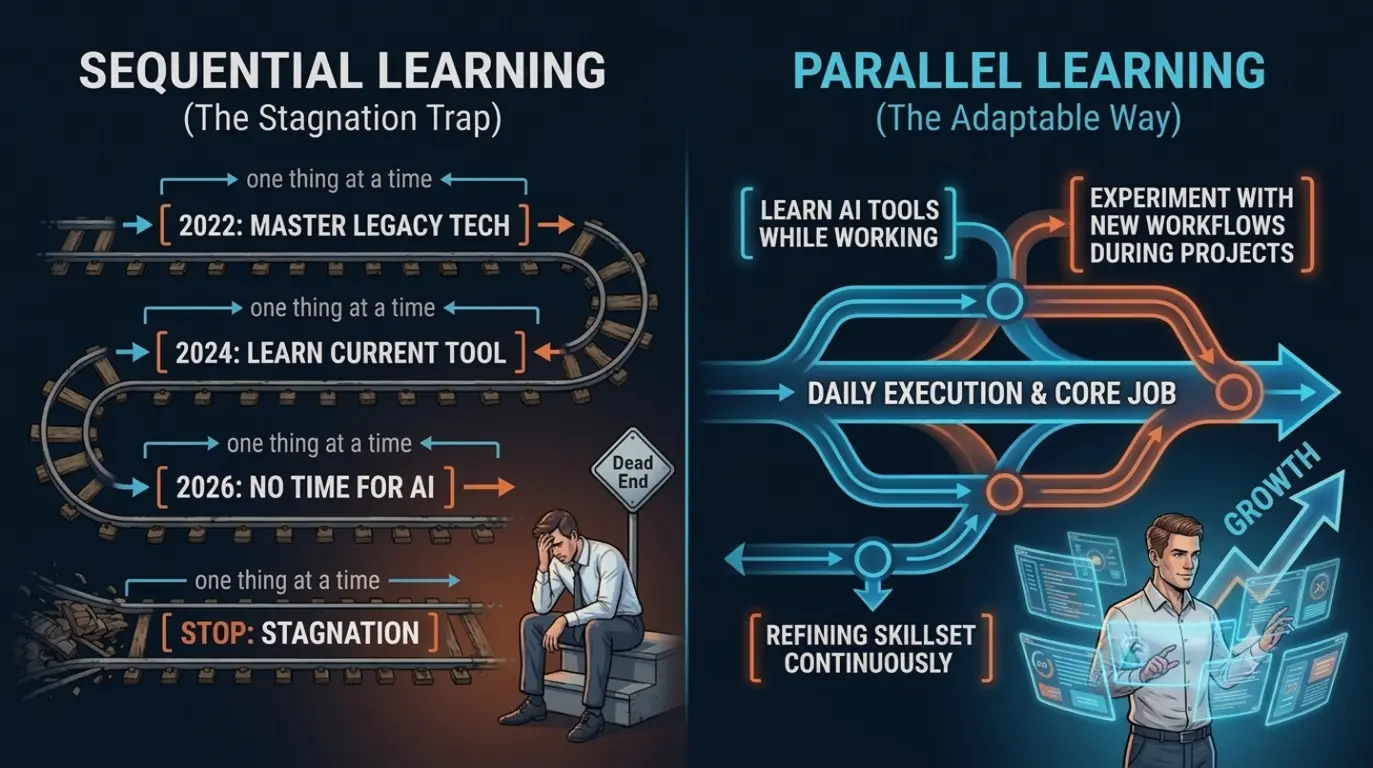
Let's face facts: learning takes effort, and very few companies will hand you paid time solely to upskill. Because this developer stuck strictly to what he knew and disregarded every chance to adapt, he couldn't keep up with the new pace and was eventually forced to quit.
Now, consider another developer in the exact same scenario. He didn't know the new technologies either. The difference? He was willing to try. Instead of complaining about the learning curve, he dug deeper to overcome the hurdles. He learned while building. As a result, his capabilities expanded, giving him the leverage to build his career path in whatever way he deemed fit.
"Learning and executing must be a parallel process, not a sequential one. In the era of rapid development, nobody waits.
The Cost of Standing Still
No one is promising that mastering a new skill is a clean or easy process. Mistakes will happen. Hurdles will appear. The only thing that matters is whether you push through or give up.
The moment you stop learning and polishing your skillset is the moment you put a full stop to your career or business growth. This is just the dawn of AI. More innovations will come, but with them, more opportunities will open up for those ready to move fast.
Always remember to adapt, stay open, and keep evolving.