
The idea for this piece started during a casual conversation with my wife. We were talking about the sheer volume of variable options available for women in clothing stores compared to the seemingly generic racks for men.
It got me thinking. It’s not that men lack distinct collections or cuts. The variations absolutely exist. In fact, the depth of technical variation is just as complex on both sides of the store. But why are men's items relegated to generic, functional names (a shirt, a jacket, pants), while women's fashion possesses a hyper-specific vocabulary for every conceivable iteration (a peplum blouse, an A-line skirt, culottes)?
To a Product Designer, this isn't just about clothes. It’s a physical manifestation of how different mental models govern the way we interact with systems.
The Great Male Renunciation
In product design, a mental model is the cognitive shortcut a user holds about how a system should work. If your interface aligns with their mental model, the experience feels intuitive. If it clashes, you get friction.
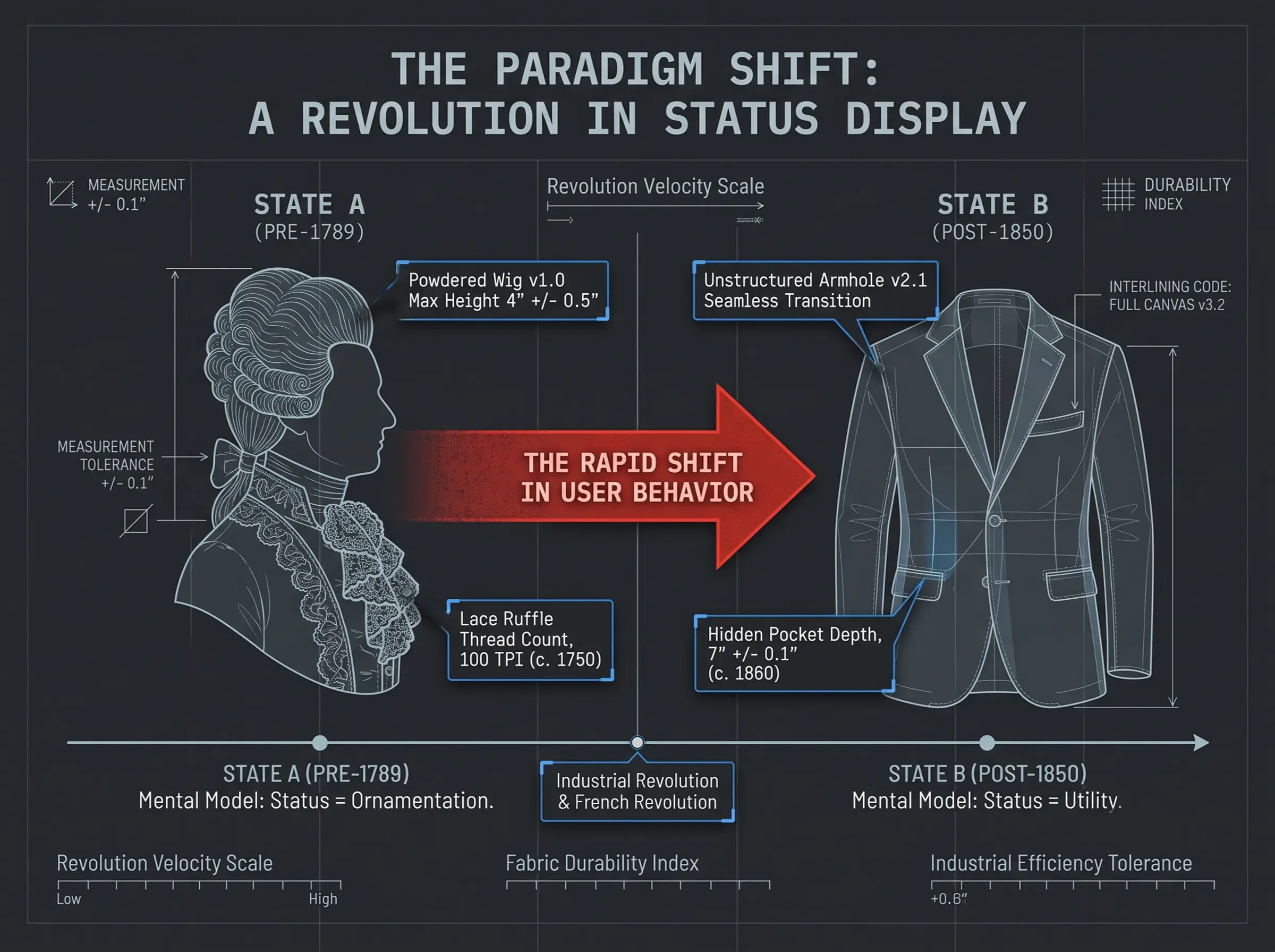
Prior to the late 18th century, the mental model for "power and status" in menswear was directly tied to visual complexity. High-status men wore powdered wigs, silk knee-breeches, and heavily embroidered coats.
Then, the French Revolution and the Industrial Revolution happened. The user environment completely changed. Looking wealthy became physically dangerous, prompting men to abandon silk knee-breeches for working-class trousers. Over the next few decades, this survival tactic evolved into a new uniform for the Industrial Revolution. Men adopted the dark wool suit.
"The mental model for power shifted overnight. Status was no longer tied to ornamentation, but to industry, utility, and rationality.
It was a completely new design system optimized for a new reality. Men's fashion stopped trying to stand out and started trying to blend in.
Spec Updates vs. Product Launches
This historical pivot perfectly explains the naming convention discrepancy we noticed.
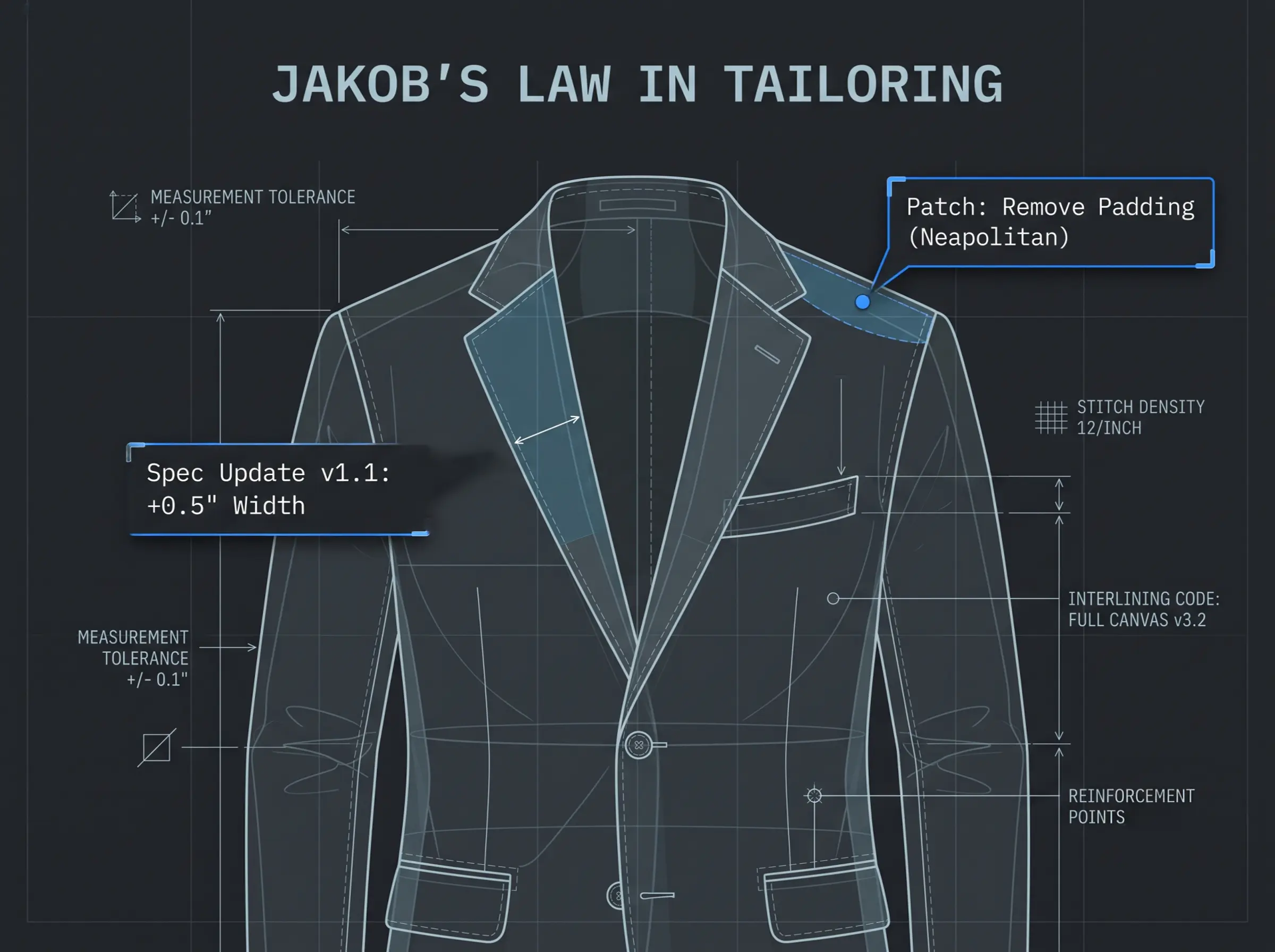
Once the modern suit was established, men's fashion became the ultimate physical embodiment of Jakob’s Law. Jakob’s Law states that users spend most of their time on other sites, so they expect your site to work exactly like the ones they already know. Men expect their clothing to fit a locked, standardized macro-framework. Menswear operates on a strict global Design System.
Because the overarching system is fixed, the items only need generic, functional names. The innovation happens entirely in the micro-interactions. A half-inch wider lapel, a deeper trouser pleat, or the unlined shoulder of a Neapolitan cut are treated like minor spec updates or software patches. They refine the existing system, so they keep the same generic parent name.
Women’s fashion operates on a completely different model. It is driven by constant aesthetic reinvention. Dropping the waistline in the 1920s or adding massive shoulder pads in the 1980s isn't a micro-adjustment; it acts as an entirely new product launch. That constant macro-silhouette change requires a highly specific vocabulary to establish and sell the new structural identity of the garment.
Rewriting the Interface
Mental models are deeply ingrained, but they are not permanent. However, you cannot force a user’s mental model to change through design alone. You must offer a clear, immediate upgrade in utility or cognitive ease.
When you do need to shift a rigid mental model, whether in a physical product or a digital interface, it usually happens in one of three ways:
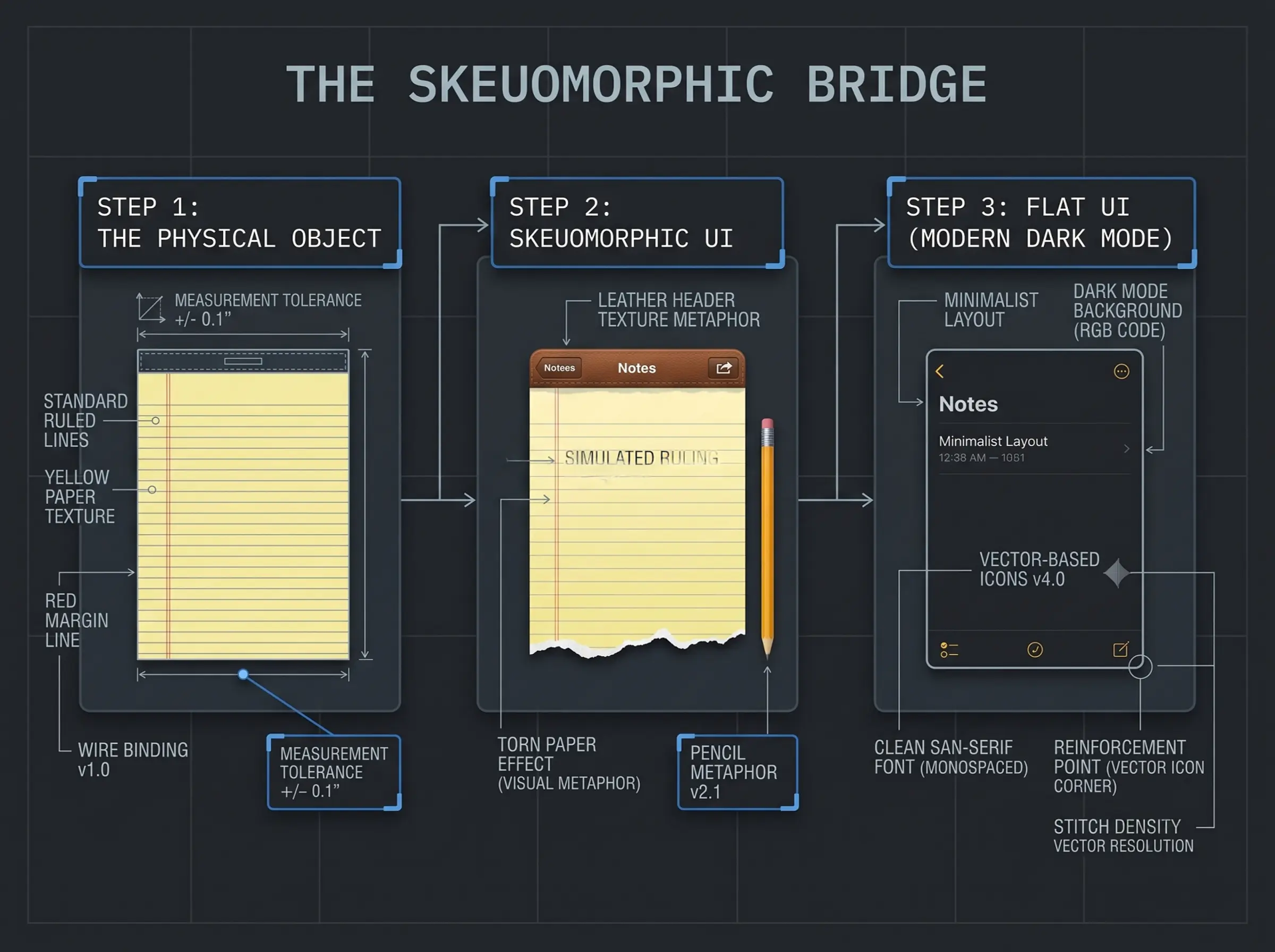
- The Skeuomorphic Bridge: When Apple launched the iPhone, the existing mental model for a phone involved physical, tactile buttons. To teach the entirely new interaction paradigm of a touchscreen, Apple used skeuomorphism. The Notes app looked like a physical yellow legal pad; the bookshelf had rich wood grain. They used familiar visual textures to bridge the gap to a new model. Once the world understood how touch interfaces worked, Apple stripped away the textures and moved to flat design.
- Incremental Normalization: You can completely rewrite a rigid user preference if you just push the baseline slightly year over year. In 2005, skinny jeans looked absurd to most men. But by incrementally tapering the hem width of standard straight-leg jeans over several seasons, the fashion industry adjusted the baseline mental model of what a "normal" pant leg looked like, until wide legs suddenly felt sloppy.
- The 10x Utility Paradigm: Users will stubbornly cling to an old mental model unless the new one is significantly faster or better. Tinder changed the mental model of binary decision-making by replacing a click with a swipe. It was so frictionless and effective that this gesture-based model is now used in everything from email triage to task management apps.
Whether you are designing a wardrobe or a complex fintech platform, the core question remains the same. Are you building a men's suit, relying on a deeply established framework and innovating quietly on the micro-details? Or are you designing a runway collection, forcing the user to learn a completely new interaction paradigm?
Just as the rigid historical binary of men's and women's clothing is currently blurring into more adaptive, gender-neutral fashion, even the most rigid software mental models eventually have to evolve into more flexible, inclusive user experiences. The framework is never truly set in stone.