
There is a misconception that a great idea is enough to build a successful product. But the truth is, building a product without UX research isn't a strategy; it’s just a game of luck.
When a business skips this critical phase, stakeholders are essentially gambling. They are blindly hoping customers will interact with the solution exactly as the founders envisioned, rather than designing for actual human behavior.
"The market doesn't adapt to your product. Your product has to adapt to the market.
Phase 1: Generative Research and Finding the Gap
Proper research starts at the very beginning with Generative Research. This is where you identify the audience that actually needs the solution.
This requires a thorough gap analysis. Every successful product fills a gap, an unresolved issue faced by users despite the existing solutions in the market. But identifying the gap isn't enough. You have to ask: Will filling this gap actually attract users? And more importantly, Does it make business sense? ROI must be considered for every product, because at the end of the day, money matters.
Sometimes, discovery reveals that your planned product needs a massive pivot. Other times, it shows that the idea should be dropped entirely. Not every concept works, and that is a reality businesses need to accept.
"It is infinitely better to drop a doomed idea early than to spend a fortune trying to force it to fit a market that doesn't exist.
Phase 2: Evaluative Research and The Sweet Shop Illusion
Once you have a product or a prototype, you move into Evaluative Research to test if your solution actually works. But simply collecting data isn't enough; you have to interpret it correctly.
A fascinating UX case study I once reviewed highlighted a company that produced and distributed sweets to retail shops. They did their initial research, ran a user acceptance test, and tracked quantitative sales data across 10 shops in different areas. The sweets were a hit. They expected shops to reorder in 7 days, but 4 out of the 10 shops called back in just 3 days.
Thrilled, they immediately scaled up to 100 shops. But they overlooked critical factors. They didn't analyze the data on product reselling, and they completely ignored geographical density. Initially, the 10 shops were spread out over a vast area. The expanded network of 100 shops was much closer together, effectively cannibalizing each other's sales. The sales graph plummeted, but they had already invested heavily in machinery and transportation, resulting in a severe loss.
If they had practiced triangulation, combining their quantitative sales figures with qualitative data, like interviewing shop owners about local foot traffic, they would have caught this beforehand.
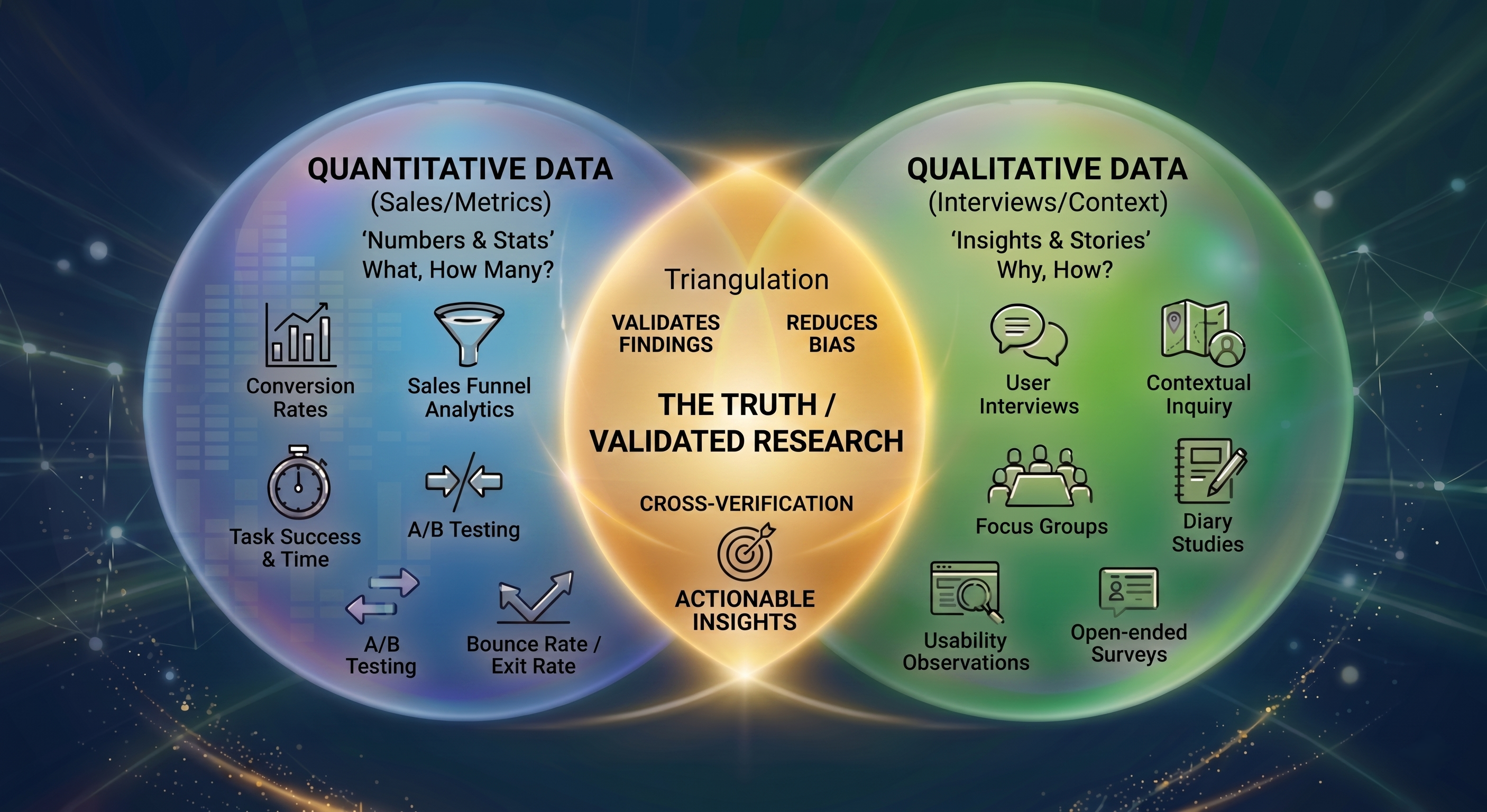
Phase 3: The Trap of Confirmation Bias
Here is the thing that is most often indirectly overlooked: research must be unbiased. Confirmation bias (conducting research just to justify an existing idea) is the reason most startups fail.
In my years designing products and shaping UX strategy, I've seen this exact bias play out firsthand. I once worked on the UX research of an EdTech app for a training institution. They were providing offline classes and wanted to sell the same course online at a much lower price.
The data was clear: while the app would achieve great reach if marketed properly, it would drastically reduce the new sign-ups for their premium physical classes.
But the client believed otherwise. They were convinced that the app downloads would subsequently lead to upselling. Instead of looking at the objective data, they suffered from survivorship bias. They leaned entirely on positive feedback from a few of their students and well-wishers who confirmed their pre-existing beliefs, ignoring the appropriate target audience.
"If someone presents research data and uses the phrase, 'As we know...', that isn't research. That is an assumption.
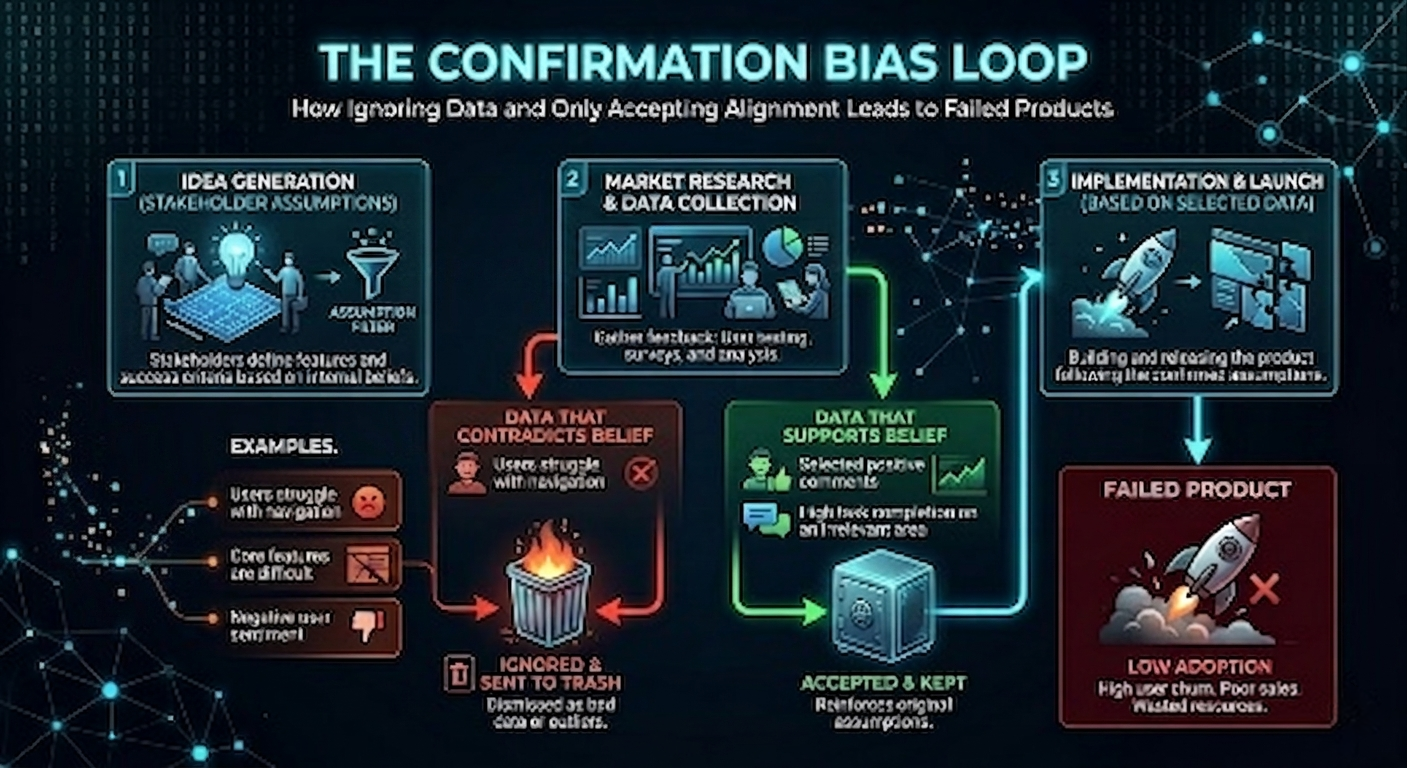
The result? Just as the research predicted, new sign-ups in the actual physical classes dropped. Eventually, they had to pivot and turn the app into a supplementary add-on that could be renewed later. Real validation is data-driven, backed by actual human experience.
The Verdict: Continuous Discovery
Human behavior shifts from period to period. Because of this, research isn't a one-and-done checkbox you tick before development. It requires Continuous Discovery. You must be on the ground, conducting the right surveys, contextual inquiries, and live data collection to understand the true scope of a solution. You won't find this data just by searching the web.
To those oblivious to the process, UX research might seem like a waste of time or a roadblock to launching. But a proper, unbiased research wing will always save you time, save you money, and ultimately bring in much greater results.
Stop trying to reverse-engineer justifications for why an idea fits the market, and go for the truth. Because in product design, your belief is not the truth; the data is.